

Jayapura, Jubi – On 13 February 2026, Wereldmuseum Leiden will open the new exhibition Time for Papua: an impressive presentation of 400 objects selected from the world’s largest Papua collection originating from western New Guinea. The collection, partly formed during the colonial period, calls for an approach grounded in context, historical connectedness, and responsibility. Time for Papua builds on this by showing both the traditional and contemporary significance of these objects. For the first time in sixty years, the collection is being presented on this scale, bringing together historical objects with contemporary art and voices from Papua and the Dutch diaspora.
In Time for Papua, visitors gain insight into the dynamic Indigenous cultures of Papua, with roots reaching back as far as 42,000 years. The exhibition emphasises Papua’s rich artistic and maker traditions, which have had a profound influence on global art history and remain highly relevant today. With contributions from Dutch Papuans, Papua filmmakers and contemporary artists, the presentation focuses on the western part of New Guinea.
“The result is a layered narrative that offers visitors a nuanced understanding of Indigenous lifeworlds and demonstrates how these are closely intertwined with a non linear conception of time in which ancestral presence is fundamental—shaping both everyday experience and a refined creative practice that has evolved over many centuries,” Casper van de Kamp, Wereldmuseum’s Pers‑ & Corporate communicatie said.
Casper also explained The exhibition also explores the historical relationship between Papua and the Netherlands and the colonial past, challenging visitors to look beyond known narratives through Papua art firmly situated in the present
In light of current crises, in which ecosystems and Indigenous ways of life are under severe pressure, these objects take on renewed and deeper meaning for Papuans in New Guinea, in the diaspora, and internationally. Time for Papua emphasises the importance of the collection today as a source of knowledge, representation, and vision of the future for communities in the region and the diaspora – revealing not only what was, but also why now is the time for Papua.
Dicky Takndare, an artist from Papua who participated in the “Time for Papua” exhibition, said he donated a sculpture of Arnold Ap to the exhibition.
“The Arnold Ap sculpture is titled ‘Singing for Life’. The nearly 3-meter-tall polyester sculpture is dedicated to the late Arnold Ap, a Papuan cultural figure who dedicated his life to Papuan culture,” said Takndare, who is currently studying fine arts at the Rijksakademie.
Takndare also said that two hours before the opening, Carolina “Corry” Ap-Bukorpioper (wife of the late Arnold Ap) and her family were given the opportunity by the Wereldmuseum to perform a ritual procession with the statue.
TIME FOR PAPUA – A history spanning thousand of years
Around 10,000 years ago, Papuans were among the world’s earliest farmers, and trade played a key role from an early stage. Timber species, nutmeg, pearls, stone, tortoiseshell, and birds-of-paradise feathers – and, in certain periods, also enslaved people – were exchanged for valuable materials such as bronze, beads, porcelain, tobacco, and textiles.
These trade networks extended across hundreds of kilometres around New Guinea and into even larger international systems. Canoes were the principal means of transport. Art forms such as woodcarving, weaving, and body adornment evolved continuously, exerting a lasting influence on art and design worldwide. The exhibition also shows how, from the mid-nineteenth century onwards, missionaries reshaped Papuan ways of life – reframing them in some respects, while also placing them under threat through the active promotion of a capitalist and colonial worldview geared towards global exploitation. Themes such as mining – including the world’s largest gold and copper mine – and the palm oil economy are also addressed.
The exhibition connects historical objects with contemporary works – from korwar figures and canoe prow carvings to recent work by Udeido Collective, Kevin van Braak and Dicky Takndare, as well as newly produced films by Papuan Voices. Through the exhibition, visitors are invited to reflect on the past and the present, while also looking ahead to a just, inclusive, and sustainable future.
FOUR THEMES – 400 highlights from The World’s largest Papua collection
With nearly 50,000 objects, Wereldmuseum manages the world’s largest Papua collection from western New Guinea. This collection is closely connected to Dutch colonial history, the development of art history, the interest of European artists and collectors of Papua art during the twentieth century, and contemporary artistic relationships between the Netherlands and Papua. The objects speak to craft traditions and worldviews in which time is not linear, and past, present, and future can exist simultaneously.
For Time for Papua, a selection of 400 key works has been made from this collection. Divided into four thematic chapters, the exhibition unfolds as a layered story that invites visitors to look beyond known narratives, sheds light on centuries-old and contemporary traditions and networks, and highlights the creativity and resilience of Papuans as they continue to shape Indigenous art and ways of life. In addition, Time for Papua creates space for dialogue about time and temporal experience, offering new ways to connect past, present, and future.
From the first inhabitants during the last Ice Age to later migrations from Taiwan, the theme Thousands of Years of Art and Making explores how the rich artistic traditions of diverse Indigenous Papuan cultures are deeply connected to local ecologies and ancient networks of migration and trade. Objects and artworks reflect a long history of exchange and inspiration, which also influenced Western art history.
The second theme, Converging Time, shows how Papuan communities do not always experience time linearly but rather as a dynamic concept in which past, present, and future intersect. Ancestors play an active role in everyday life and can manifest in many ways, including in the natural environment, in rituals, and in woodcarvings. These objects are not static, but form part of an ongoing cycle of life and renewal.
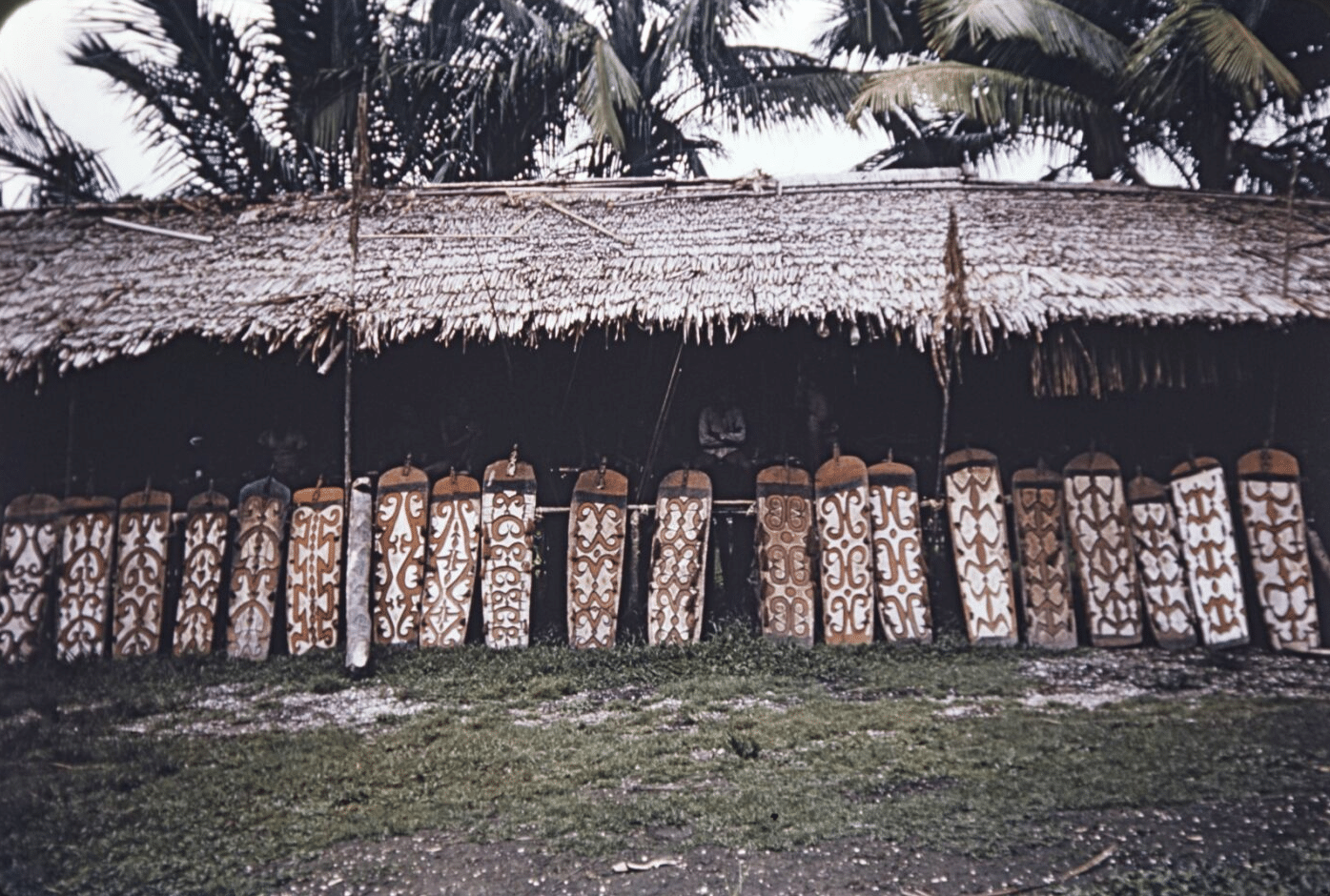
The theme Borders and Identity Over Time examines how Papuan objects and art have been shaped by borders – geographical, cultural, and conceptual. It addresses, for instance, how colonial boundary-making continues to affect political and social structures in New Guinea today, and how communities mark their identities through rituals, architecture, and body adornment. The theme also shows how ideas about gender and artistic authorship are constantly in flux between tradition and contemporary creativity.
The final theme, Changing Ways of Life, reveals how Indigenous ways of life, including artistic traditions, are under pressure due to recent and ongoing changes. Papuan cultures have always been shaped by external influences, but today’s pace is unprecedented. Mining, palm oil production, and religious influences disrupt the rhythms of land use and ritual, while ecology and economy increasingly pull in different directions. Yet the collection and the artworks testify to resilience; they are sources of knowledge, representation, and visions of the future.
Highligts in The Exhibition
• Oldest korwar in the Netherlands (c. 1850) — Female ancestor figure with a snake motif; collected in 1858.
• Spirit canoe (wuramon) (Joerat Asmat, 1956) — Represents the deceased on their journey to Safan, surrounded by water spirits.
• Two bis poles (c. 1960) — Carved by, among others, Mbatumos and Bifarq; with provenance links to the Rockefeller collection.
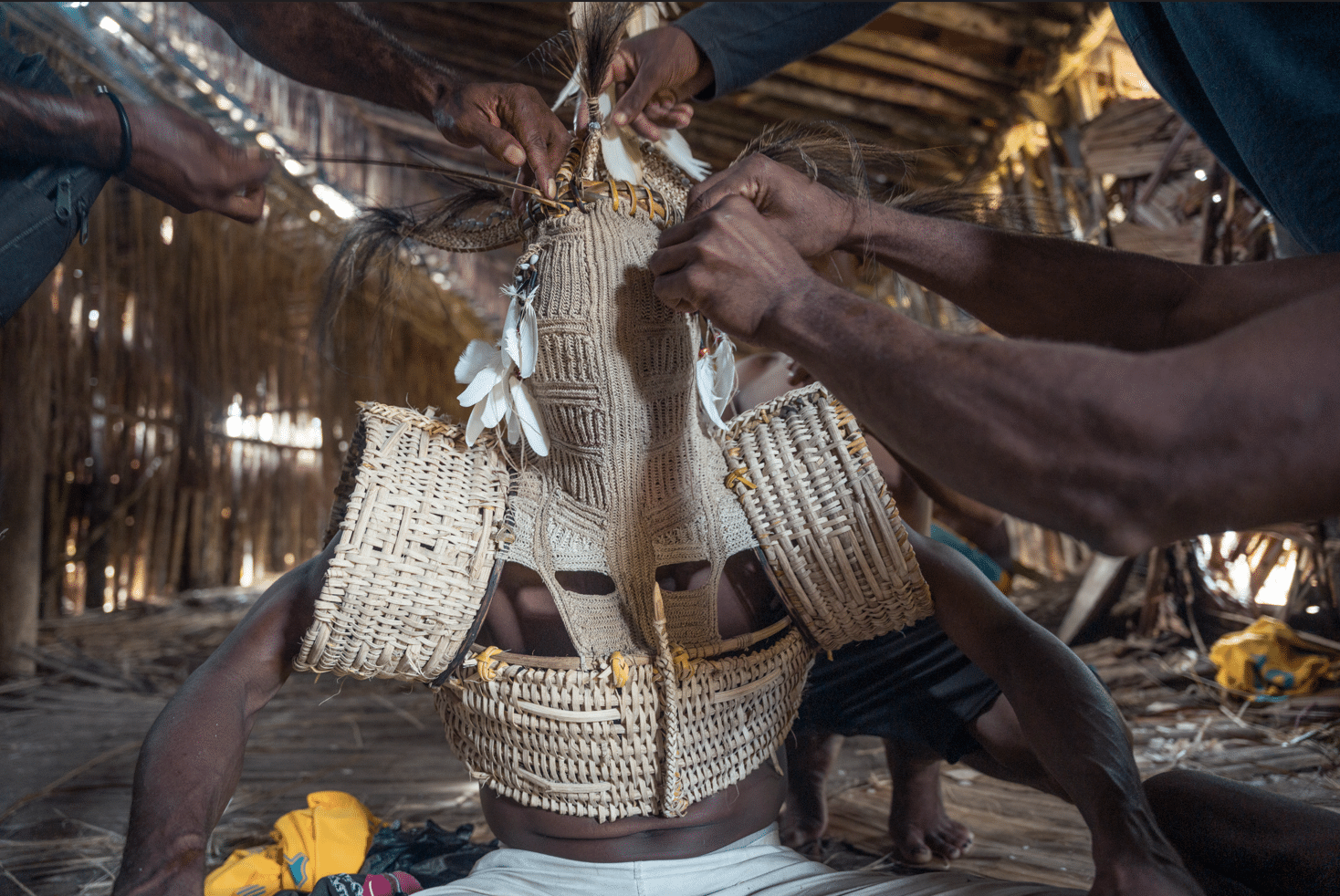
• Doroe mask costume (c. 1960) — From Emari Ducur; the dead are believed to return briefly during jipae / je ti ritual performances.
• ‘Ancestor from Vondelpark’ (2000) — Roman Omomá & Rufus Sati (Asmat) carved a kawe ancestor figure in Amsterdam from an upended tree; an iconic encounter between places and times.
• Mythological serpent (Biak/ Raja Ampat, early 20th century) — Spirit figure used to determine favourable departure times and winds, with offerings made during storms.
• Canoe prow with Chinese porcelain (Biak) — Tangible evidence of centuries-long Asian trade networks.
• Dong Son bronze (6th century BCE—1st century CE) — Early metalwork connections via Vietnam; rare and spectacular.
• Terfo weaving tradition (Sobei/Sarmi) — Historic loom alongside a contemporary revival.
• Calcite spatulas & house posts (Sentani) — Human figures symbolising the bond between ancestors and descendants.
• Bark cloth (maro), made in 1996 by artist Agus Ongge (b. 1954) from the Sentani Lake region — The lizard-like ancestor figures are based on historical motifs.
• Calcite holder (pre-1930) made from coconut, with spiral motifs characteristic of the Sentani Lake area. TM-608-21a/b
• Bronze axe blade (pre-1st century CE) brought to the Sentani Lake region by Dong Son traders from Vietnam. RV-1528-446
Contemporary Art, Loans and Papuan Voices
Alongside objects from its own collection, Time for Papua includes loans from national and international partners, including the Musée du Quai Branly – Jacques Chirac in Paris, as well as loans and new work by visual artists and filmmakers.
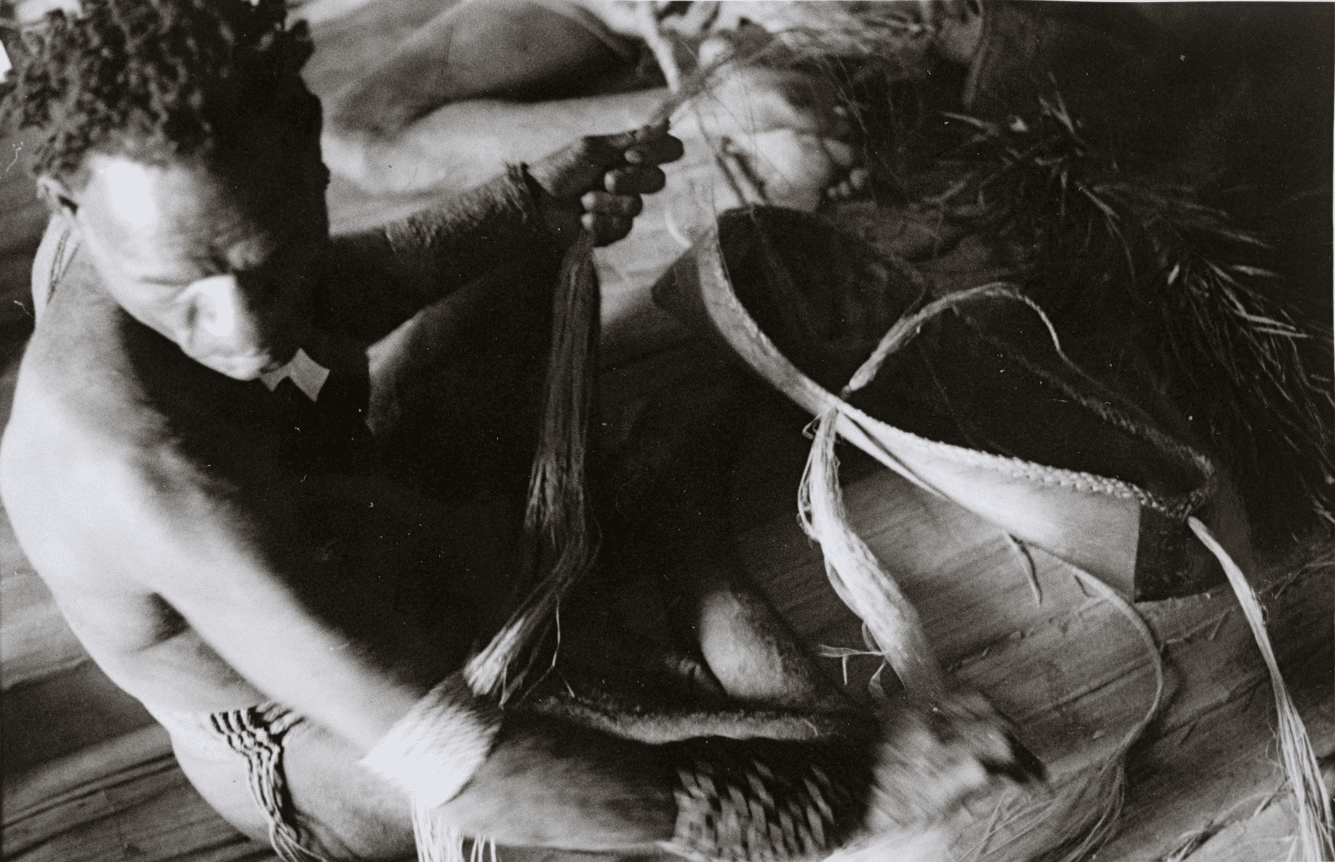
Especially for this exhibition, Musée du Quai Branly has restored several of the oldest works collected in the early nineteenth century along the north coast of New Guinea. These objects bear witness to refined traditions of plaiting and to early encounters with Europeans.
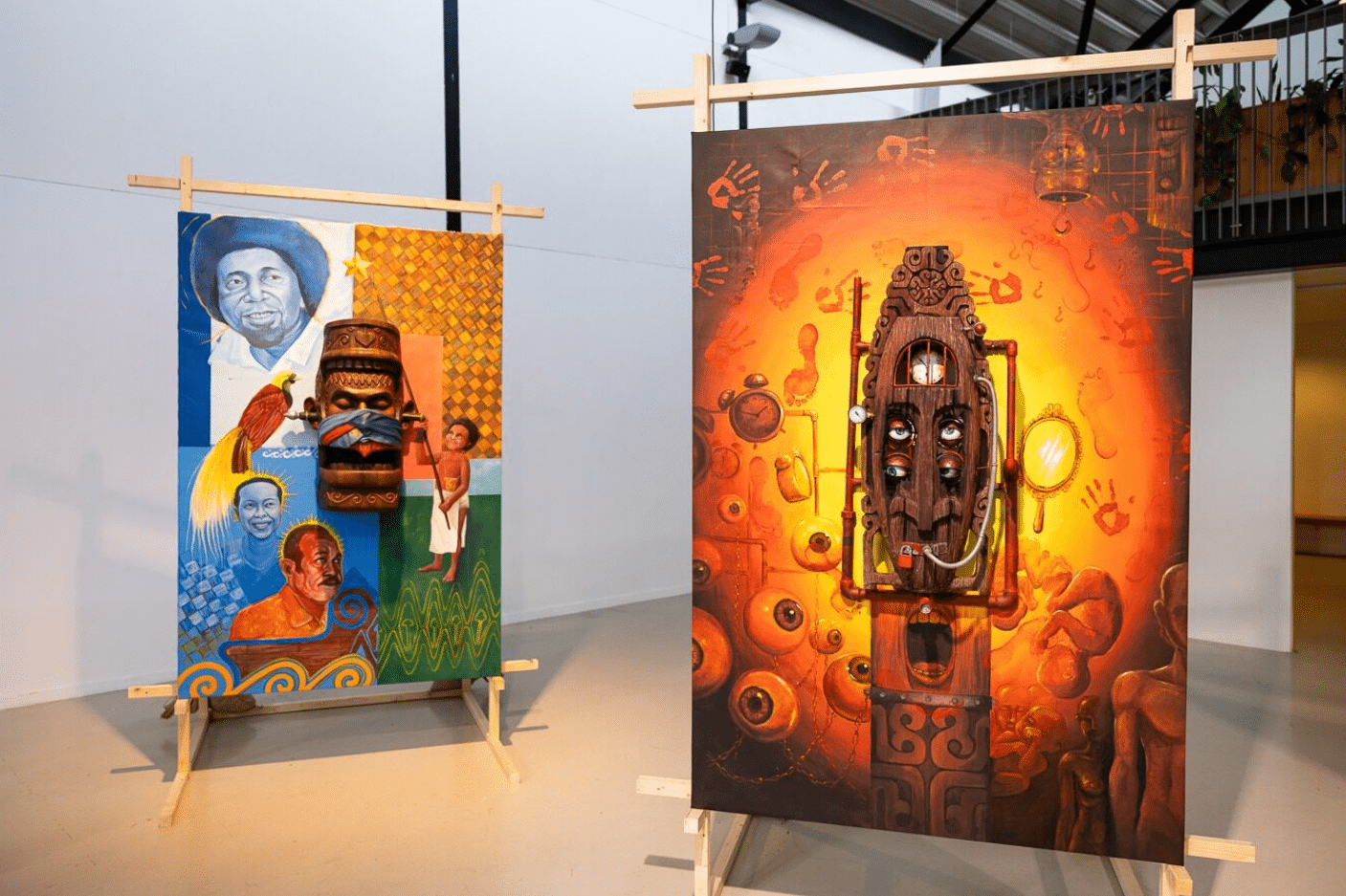
Throughout the exhibition, artist Kevin van Braak and the Udeido Collective from Papua present their series Hidden Faces of Papua (2018-2025). In a sequence of seven mask-based paintings, they offer a sharp reflection on contemporary realities in western New Guinea that remain globally underexposed and, in many cases, ‘masked’, such as the oppression of Indigenous communities, the extraction of natural resources, and the ongoing threat to Indigenous ways of life.
In addition, visual artist Dicky Takndare from Jayapura, currently an artist-in-residence at the Rijksakademie Amsterdam, has created new work specifically for this exhibition, focusing on the anthropologist and cultural leader Arnold Ap.
Papuan Voices, a network of filmmakers in western New Guinea, has produced four new short films in different regions, united by ‘time’ as a shared theme.
Interaction & Public Programme
The public programme (dates to be announced) includes artist talks, lectures, educational activities, and family programmes – ranging from hands-on workshops in weaving and plaiting to discussions on provenance research and ecological justice.
From 23 to 27 June 2026, the international PAA symposium Oceanic Blazing Forms will take place at Wereldmuseum Leiden. Speakers from across Oceania, including Papua, will engage with the exhibition’s themes, bringing international debates on art and identity to Leiden.
In addition, Papua will be highlighted through the Research Center for Material Culture’s programme on heritage and ecology, which includes conferences and events focused on ecological and cultural conservation. The documentary The Promise (2025) by Daan Veldhuizen, which examines the impact of geopolitics and economic interests since the 1960s, provides important context for the historical relationship between Papua and the Netherlands. The film will be broadcast on NPO 1, screened in cinemas, and shown on several occasions at Wereldmuseum Leiden.
Together, this interplay of museum activities, academic debate, and film creates a unique momentum: Time for Papua is more than an exhibition – it forms part of a broad societal conversation about Papua, in the Netherlands and abroad.(*)


Discussion about this post